A couple of months ago, I was sitting in a meeting where a team proudly demoed their brand-new AI tool. It could summarize reports, generate insights, even predict customer churn.
Everyone nodded. It looked impressive.
Then someone asked a simple question: “Who’s responsible if it gets something wrong?”
Silence.
That moment stuck with me. Because if I’m being real, that’s where most AI transformation efforts quietly fall apart—not in the technology, but in the lack of governance.
💡 Why This Matters More Than Ever in 2026
AI transformation is everywhere in 2026. Companies are racing to adopt it—automating workflows, replacing manual processes, and building “AI-first” strategies.
But here’s what surprised me: the biggest failures I’ve seen had nothing to do with bad models or weak data.
They failed because no one owned the decisions.
No clear rules.
>No accountability.
>No structure for how AI should actually be used.
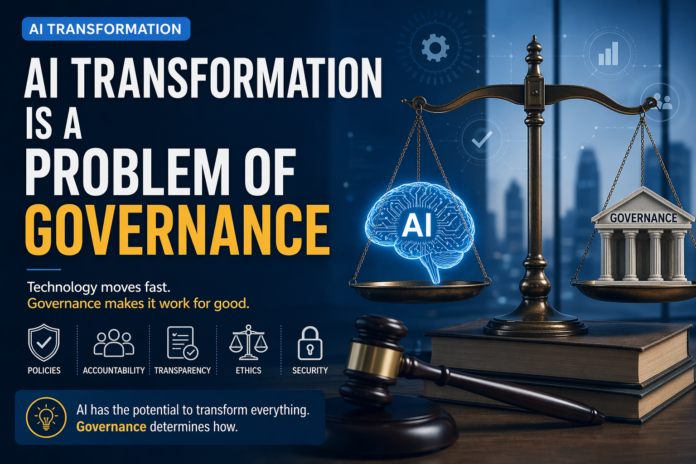
And that’s why AI transformation is a problem of governance, not just innovation.
It’s not about what AI can do.
It’s about how people manage it.
🔥 The Biggest Misconception About AI Transformation
Most teams treat AI like a tool upgrade.
They think:
- “Let’s plug in AI”
- “Let’s automate this workflow”
- “Let’s replace manual work”
From my experience, that mindset is the root of the problem.
Because AI isn’t just a tool—it’s a decision-maker.
And the moment you let a system influence decisions, you’re no longer dealing with software. You’re dealing with responsibility.
That’s governance.
🧠 What Governance Actually Means (Without the Buzzwords)
Let’s keep this simple.
ai transformation is a problem of governance
Governance in AI transformation is basically:
- Who decides what AI can do?
- Who checks if it’s right?
- What happens when it’s wrong?
That’s it.
No complicated frameworks needed to understand the core idea.
But in reality, most organizations skip this entirely.
They focus on:
- Models
- Data pipelines
- Tools
But ignore:
- Decision ownership
- Risk boundaries
- Accountability
And that’s where things start to break.
💬 What I Noticed Working With AI Systems
I’ve worked with a few AI-driven tools—automation platforms, analytics assistants, even content generation systems.
Here’s the honest truth:
The tech usually works fine.
The confusion comes from people.
For example:
- One team assumes AI outputs are “final”
- Another treats them as “suggestions”
- Leadership expects accuracy, but doesn’t define acceptable error
That mismatch creates chaos.
Not because AI is unreliable—but because no one agreed on how it should be used.
⚠️ Where AI Transformation Quietly Fails
Let me break down a few patterns I’ve personally seen.
1. No Clear Ownership
Everyone uses the AI. No one owns it.
So when something goes wrong:
- IT blames the vendor
- Business blames IT
- Leadership blames “the system”
And nothing gets fixed.
2. Over-Automation Without Oversight
This one is common.
Teams get excited and automate everything.
But they forget to ask:
- Should this decision be automated?
- What’s the risk if it’s wrong?
I’ve seen companies automate customer responses… and accidentally send incorrect or inappropriate messages at scale.
Not a great look.
3. Blind Trust in AI Outputs
Here’s something people don’t like to admit:
Once AI gives an answer, people tend to trust it—even when they shouldn’t.
From my experience, this happens more than expected.
Especially when:
- The output looks polished
- The system is branded as “smart”
- There’s pressure to move fast
Without governance, no one questions the output.
💡 The Small Truth Most People Don’t Talk About
AI doesn’t remove decision-making.
It just moves it.
Instead of asking:
“What should we do?”
You’re now asking:
“Should we trust what the AI says?”
That’s a completely different type of decision.
And if no one is assigned to make it, you end up with silent risks building up over time.
🛠️ How to Approach AI Transformation the Right Way
If I could go back and reset how most teams approach AI transformation, I’d focus on governance first—not tools.
Here’s what actually works.
1. Define Decision Boundaries Early
Before implementing AI, ask:
- What decisions can AI influence?
- What decisions must remain human?
This sounds basic, but most teams skip it.
2. Assign Real Ownership
Someone needs to own:
- The system’s outputs
- Its risks
- Its performance
Not in theory—in practice.
If no one owns it, no one improves it.
3. Build Feedback Loops
AI isn’t “set and forget.”
You need:
- Regular reviews
- Error tracking
- Continuous improvement
From my experience, this is where the real value comes from.
4. Set Acceptable Risk Levels
Here’s a question most teams avoid:
“How wrong is acceptable?”
Because AI will make mistakes.
Governance means deciding:
- Which mistakes are okay
- Which ones are not
5. Train People, Not Just Systems
This is huge.
You can’t just deploy AI and expect people to “figure it out.”
Teams need to understand:
- How AI works (at a basic level)
- When to trust it
- When to question it
Otherwise, you get blind reliance—or complete rejection.
🔍 A Real-World Scenario (That Happens More Than You Think)
Let’s say a company uses AI to prioritize customer support tickets.
Sounds efficient, right?
But here’s what actually happens without governance:
- AI prioritizes based on past data
- High-value customers get faster responses
- Smaller customers get delayed
Over time:
- Smaller customers churn
- No one notices why
- The AI keeps optimizing the same pattern
This isn’t a tech failure.
It’s a governance failure.
No one defined fairness.
>No one monitored outcomes.
>No one questioned the system.
ai transformation is a problem of governance
⚖️ The Honest Truth About AI Transformation
Here’s the part most blogs won’t say:
AI transformation is messy.
Not because AI is bad—but because organizations aren’t used to governing systems that “think.”
From my experience:
- Teams underestimate complexity
- Leadership overestimates speed
- Everyone assumes someone else is responsible
And that combination creates risk.
🧩 Things to Keep in Mind (Before You Go All-In)
1. AI Scales Problems, Not Just Solutions
If your processes are unclear, AI will amplify that confusion.
2. Governance Slows You Down (At First)
And that’s a good thing.
Because moving fast without control usually leads to bigger issues later.
3. You Can’t Eliminate Risk—Only Manage It
Anyone promising “perfect AI” is overselling.
The goal isn’t perfection.
It’s control.
4. Culture Matters More Than Tools
If your team doesn’t question outputs, governance won’t work—no matter how good your system is.
🚀 Actionable Steps You Can Start Today
If you’re serious about AI transformation, here’s what I’d recommend:
- Audit your current AI use
- Where is AI already influencing decisions?
- Map decision ownership
- Who is accountable for each system?
- Introduce review checkpoints
- Weekly or monthly reviews of AI outputs
- Create simple guidelines
- When to trust AI
- When to escalate to humans
- Start small
- Don’t automate everything at once
From my experience, small, controlled implementations outperform big, chaotic rollouts every time.
🎯 Final Thoughts: It’s Not About the AI
If I had to sum it up:
AI transformation isn’t failing because of bad technology.
It’s failing because organizations haven’t figured out how to govern it.
And honestly, that’s understandable.
We’ve never had systems like this before.
But ignoring governance isn’t an option anymore.
Because the more AI you adopt, the more invisible decisions it makes.
And those decisions? They shape your business.
ai transformation is a problem of governance
❓ So Here’s the Real Question
If AI is already influencing decisions in your organization…
Who’s actually in charge of those decisions?

. A couple of months ago, I was in a meeting)