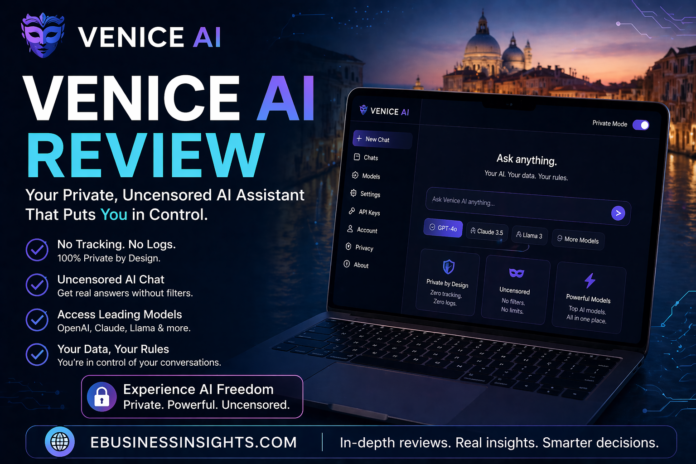
The Question That Made Me Try Venice AI
I’ll be honest—this started with a simple thought:
“Where does all my AI data actually go?”
I’d been using different AI tools daily—writing, brainstorming, testing ideas. But at some point, it hit me…
Everything I typed was going somewhere.
Stored. Logged. Possibly analyzed.
That’s when I came across Venice AI.
It positioned itself differently—not as the smartest AI, not the fastest… but as the private one.
And that instantly made me curious.
So I gave it a proper try.
Not just a quick test—but using it as part of my daily workflow.
Here’s what I found.
💡 Why Venice AI Matters in 2026
By 2026, AI isn’t new anymore.
Everyone’s using it:
- For writing
- Coding
- Research
- Even personal conversations
But here’s what surprised me:
Very few people actually think about privacy.
Most platforms:
- Store prompts
- Use data to improve models
- Keep logs longer than you’d expect
And for casual use, that might be fine.
But if you’re:
- Working on sensitive ideas
- Handling client data
- Or just value privacy
That’s where Venice AI steps in.
It’s built around one core idea:
Your data stays yours.
🧠 What Venice AI Actually Is (Without the Hype)
Let me break it down simply.
Venice AI is:
- A conversational AI platform
- Similar to tools like ChatGPT
- But focused on privacy and local-first processing
That means:
- Conversations aren’t stored in the same way
- There’s less tracking
- More control over your data
From my experience, it feels like a “cleaner” version of AI interaction.
Less polished in some areas—but more intentional.
🔥 My First Experience Using Venice AI
When I first opened Venice AI, I expected it to feel limited.
Usually, when something focuses on privacy, you lose performance.
But what surprised me was…
It actually held up pretty well.
I tested it with:
- Writing prompts
- Idea generation
- General questions
And while it wasn’t always as sharp as some big-name tools…
It was consistent.
And more importantly—it felt… quiet.
No weird suggestions.
No aggressive “optimization.”
Just straight interaction.
That’s rare.
💬 What Stood Out Immediately
1. The Privacy Angle Feels Real (Not Just Marketing)
A lot of platforms say they care about privacy.
Venice AI actually builds around it.
From my experience:
- You’re not constantly reminded about data usage
- You don’t feel like your inputs are being “watched”
It’s subtle—but it changes how you use the tool.
You’re more open.
More relaxed.
2. It Feels Less “Commercial”
This is hard to explain, but I’ll try.
Other AI tools sometimes feel like:
- They’re guiding you
- Nudging you
- Optimizing responses
Venice AI feels more neutral.
Like it’s just… there.
Helping, without steering too much.
3. It Encourages Thoughtful Use
Because it’s not overloaded with features, you naturally:
- Slow down
- Think more
- Interact more intentionally
And honestly, I didn’t expect that.
⚠️ Where Venice AI Falls Short
Alright—let’s balance things out.
Because Venice AI isn’t perfect.
1. Not as Powerful as Big AI Platforms
If you’re used to:
- Highly advanced reasoning
- Complex outputs
- Deep integrations
You might feel a gap.
Venice AI is solid—but not cutting-edge in raw capability.
2. Fewer Features
No massive ecosystem.
Or endless plugins.
No “everything in one place” vibe.
From my experience, it’s more minimal.
Which can be good—or limiting—depending on what you need.
3. Occasional Performance Trade-offs
Sometimes:
- Responses take slightly longer
- Outputs feel less refined
Nothing major—but noticeable if you’re comparing side-by-side.
🧩 The Small Truth Most People Don’t Talk About
Here’s something I realized after using Venice AI for a while:
Privacy changes how you behave.
When you know your data isn’t being stored or analyzed heavily…
You:
- Ask different questions
- Explore ideas more freely
- Take more risks in your thinking
That’s not a feature you can measure.
But it’s real.
And honestly—it’s one of the biggest advantages.
🔍 A Real Scenario (That Changed My Perspective)
I was working on a sensitive idea—something I wasn’t ready to share publicly.
Normally, I’d hesitate to put it into an AI tool.
But with Venice AI, I didn’t feel that same friction.
I just… used it.
No second-guessing.
No “should I really type this?”
That’s when it clicked for me.
This isn’t just about AI performance.
It’s about trust.
🛠️ Practical Tips If You Want to Use Venice AI
If you’re considering trying it, here’s what I’d recommend:
1. Use It for Sensitive Work First
That’s where it shines.
- Personal ideas
- Early drafts
- Private notes
2. Don’t Expect “Magic” Outputs
Think of it as:
- A thinking partner
- Not a super-engine
3. Combine It With Other Tools
From my experience, Venice AI works best when:
- Paired with more powerful tools
Use Venice for:
- Privacy
Use others for:
- Heavy lifting
4. Lean Into the Simplicity
Don’t try to force complexity.
It works better when you:
- Keep things clear
- Ask focused questions
⚖️ Things to Keep in Mind (Honest Truth Section)
1. Privacy Comes With Trade-offs
You might lose:
- Some performance
- Some features
But you gain control.
2. It’s Not for Everyone
If you just want:
- Speed
- Power
- Automation
There are stronger options.
3. It’s a Different Mindset
Using Venice AI feels less like:
“Get the best answer fast”
And more like:
“Think through this safely”
4. You Still Need Judgment
Privacy doesn’t replace critical thinking.
You still need to:
- Verify outputs
- Make decisions
🚀 Who Venice AI Is Best For
From my experience, Venice AI is ideal for:
- Privacy-conscious users
- Freelancers handling sensitive work
- Creators working on early-stage ideas
- Anyone tired of being “tracked”
It’s probably not for:
- Enterprise-level workflows
- Heavy automation needs
- People chasing the most advanced AI
🎯 Final Verdict: Is Venice AI Worth It?
If I’m being real…
Venice AI isn’t trying to win the AI race.
It’s playing a different game.
And that’s what makes it interesting.
It’s not about:
- Being the smartest
- Being the fastest
It’s about:
- Being trusted
And in a world where AI is everywhere…
That might matter more than people realize.
❓ Final Thought
If you had to choose between:
A more powerful AI… or a more private one…
Which would you trust with your ideas?

, The Question That Made Me Try Venice AI.....)